Finding the best dental marketing in USA is no longer just about running a few advertisements or posting occasionally on social media. The way patients choose a dentist has changed significantly. Today, many people begin their search online, compare dental practices, read reviews, check locations, visit websites, and look for convenient ways to book an appointment before making a decision.
For dental practices across the United States, this creates both an opportunity and a challenge. A great dentist with excellent clinical skills may still struggle to attract new patients if people cannot easily find the practice online. On the other hand, a dental practice with a strong marketing strategy can build visibility, establish trust, and consistently generate new patient appointments.
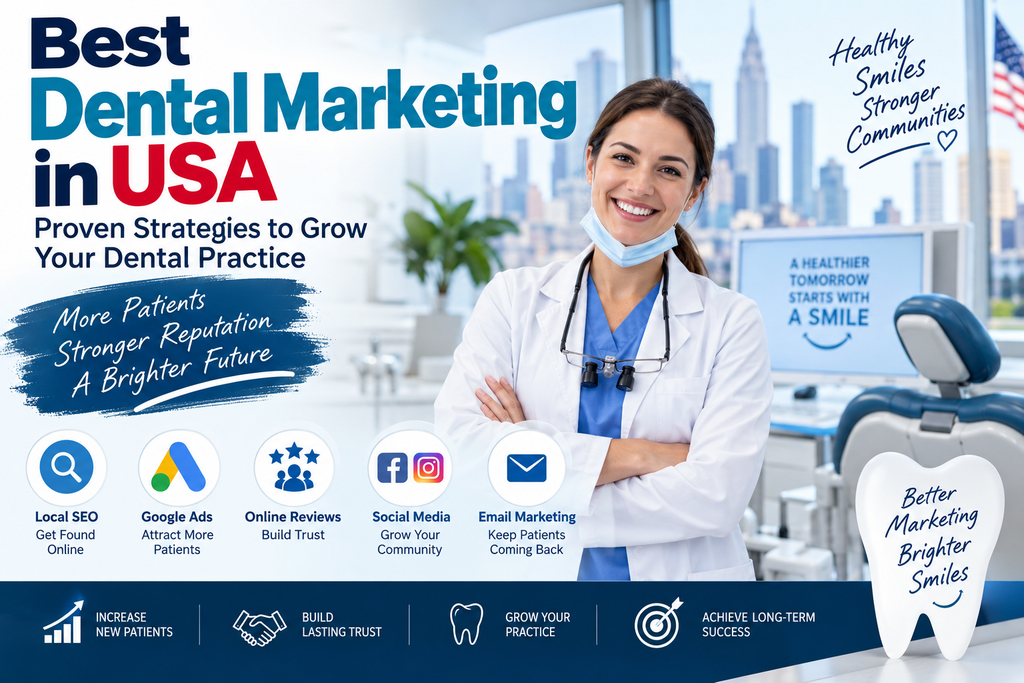
The best dental marketing strategy is not based on one single channel. It combines local visibility, search engine optimization, reputation management, paid advertising, patient communication, and a professional online presence.
In this guide, we will discuss some of the most effective dental marketing strategies for practices in the USA and explain how dentists can build a sustainable system for long-term growth.
1. Build a Professional and High-Converting Dental Website
A dental website is often the first impression a potential patient has of your practice.
When someone searches for a dentist online and clicks on your website, they should quickly understand who you are, what services you provide, where you are located, and how they can schedule an appointment.
A professional dental website should include:
- Clear information about the dental practice
- Dentist and team profiles
- Dental services
- Location and contact information
- Easy appointment booking
- Mobile-friendly design
- Fast loading pages
- Patient reviews or testimonials where appropriate
- Frequently asked questions
- Clear calls to action
One of the biggest mistakes dental practices make is focusing only on the appearance of their website. A beautiful website is helpful, but it must also encourage visitors to take action.
For example, a patient searching for an emergency dentist may not want to spend several minutes navigating through different pages. They want to quickly find your phone number, location, hours, and appointment options.
The best dental websites are designed around the patient’s needs.
2. Local SEO Is Essential for Dental Practices
Local SEO is one of the most important parts of the best dental marketing in USA.
Dental services are usually location-based. A person living in Dallas is unlikely to search for a dentist in Miami. Instead, patients use searches such as:
- Dentist near me
- Best dentist in my city
- Emergency dentist near me
- Dental implants in [city]
- Invisalign dentist in [city]
- Cosmetic dentist in [city]
This is why local search visibility is extremely valuable.
A strong local SEO strategy helps a dental practice appear when potential patients are actively looking for dental services in the surrounding area.
Local SEO usually includes:
- Google Business Profile optimization
- Location-specific website pages
- Accurate business information
- Local citations
- Service pages
- Patient reviews
- Local backlinks
- Consistent name, address, and phone number information
The goal is simple: when someone in your service area searches for a dental service you offer, your practice should have a strong opportunity to appear in relevant search results.
Local SEO takes time, but it can create long-term value for a dental practice.
3. Optimize Your Google Business Profile
A Google Business Profile is one of the most important digital assets for a local dental practice.
When patients search for dentists in their area, Google often displays local businesses along with maps, reviews, contact information, and directions.
Your dental practice profile should contain accurate information, including:
- Practice name
- Address
- Phone number
- Website
- Business hours
- Dental services
- Photos
- Appointment information
Keeping this information updated is important.
Photos can also make a significant difference. Patients often want to see the dental office before visiting. Professional images of the reception area, treatment rooms, staff, and office environment can help create a stronger first impression.
Another important part of Google Business Profile management is responding professionally to patient reviews. However, dental practices must always protect patient privacy and follow applicable privacy requirements when communicating publicly.
4. Focus on Patient Reviews and Online Reputation
Trust is extremely important in healthcare marketing.
Choosing a dentist can feel like a major decision for patients. They may be nervous about treatment, concerned about cost, or simply looking for a practice where they feel comfortable.
Online reviews can help potential patients understand how other people perceive a dental practice.
A strong reputation management strategy should focus on encouraging genuine feedback from real patients.
The process should be simple and consistent.
For example, after an appointment, a practice may use an appropriate follow-up process to ask patients for honest feedback.
Dental practices should never create fake reviews or attempt to mislead potential patients. Reviews should represent genuine experiences.
Positive reviews can help demonstrate strengths such as:
- Friendly staff
- Clean office environment
- Professional service
- Convenient scheduling
- Patient comfort
- Good communication
Even negative reviews should be handled carefully and professionally. A public response should not reveal private patient information.
A good reputation is not built overnight. It develops through consistent patient experiences and professional communication.
5. Use Google Ads for Immediate Visibility
SEO is valuable, but it usually requires time.
Google Ads can help dental practices reach potential patients more quickly.
Paid search advertising can be particularly useful for high-intent searches. For example, a person searching for:
“Emergency dentist near me”
may be actively looking for immediate treatment.
Similarly, people searching for dental implants, cosmetic dentistry, teeth whitening, or orthodontic services may already have strong interest in a particular treatment.
A well-planned Google Ads campaign can target relevant services and locations.
However, simply spending money on advertisements does not guarantee success.
A successful campaign requires:
- Proper keyword research
- Relevant ad copy
- Location targeting
- High-quality landing pages
- Clear calls to action
- Call tracking
- Conversion tracking
One important mistake is sending every advertisement to the homepage of a website.
For example, if someone searches for dental implants, the advertisement should ideally take them to a page specifically focused on dental implant services.
The easier it is for a patient to find the information they need, the better the chances of generating an inquiry.
6. Create Separate Pages for Important Dental Services
Many dental practices offer multiple services, but place all of them on one general services page.
This can make it more difficult for both search engines and patients to understand the practice’s expertise.
Important services may deserve their own dedicated pages.
Examples include:
- Dental implants
- Invisalign
- Emergency dentistry
- Teeth whitening
- Cosmetic dentistry
- Root canal treatment
- Family dentistry
- Pediatric dentistry
Each service page should clearly explain:
- What the treatment is
- Who may benefit from it
- What patients can expect
- Common questions
- Why they should consider the practice
The content should be useful and easy to understand.
Avoid writing pages only for search engines. Modern patients expect helpful information, not pages filled with repetitive keywords.
7. Social Media Can Help Build Trust and Brand Awareness
Social media may not always generate immediate appointments, but it can play an important role in building familiarity and trust.
Platforms such as Facebook and Instagram can help dental practices connect with their local communities.
Useful content ideas include:
- Oral health tips
- Educational videos
- Meet the dentist
- Meet the team
- Office updates
- Community involvement
- Frequently asked questions
- Information about dental services
Short videos can be particularly effective because they allow patients to see the personality behind the dental practice.
People often prefer to visit a healthcare provider they feel comfortable with.
A video introducing the dentist or showing the office environment may help reduce uncertainty before a patient’s first appointment.
However, dental practices should always be careful with patient photos, treatment information, and other private information.
8. Email and Patient Reactivation Should Not Be Ignored
Marketing is not only about finding new patients.
Existing patients are also valuable.
Many dental practices have patients who have not returned for regular appointments. A professional patient communication strategy can help remind people about routine care and encourage them to reconnect with the practice.
Possible communication may include:
- Appointment reminders
- Recall reminders
- Follow-up communication
- Educational newsletters
- Practice announcements
The goal should be to provide useful and relevant communication rather than sending excessive promotional messages.
Patient communication should also follow applicable privacy and communication regulations.
9. Referral Marketing Still Works
Digital marketing is important, but traditional word-of-mouth referrals continue to be valuable.
People often trust recommendations from friends, family members, and colleagues.
The best way to generate more referrals is to create an excellent patient experience.
Marketing cannot permanently fix a poor patient experience.
A friendly receptionist, clear communication, respectful treatment, convenient scheduling, and professional care can all contribute to stronger patient relationships.
When patients have a positive experience, they are naturally more likely to recommend the practice.
This makes patient experience one of the most important forms of dental marketing.
10. Track Results Instead of Guessing
One of the biggest mistakes in dental marketing is spending money without measuring results.
A practice should know where new patients are coming from.
Possible sources include:
- Google Search
- Google Maps
- Google Ads
- Social media
- Referrals
- Email campaigns
- Local partnerships
Important metrics may include:
- Phone calls
- Website inquiries
- Appointment requests
- Booked appointments
- New patients
- Cost per lead
- Cost per booked appointment
Clicks and website traffic can be useful metrics, but they are not the final goal.
The real objective is to generate qualified patients and build a healthy dental practice.
A marketing campaign that generates thousands of website visitors but very few appointments may need improvement.
On the other hand, a campaign with lower traffic but a high number of booked appointments may be much more valuable.
11. Build a Complete Dental Marketing Strategy
The best dental marketing in USA usually comes from combining multiple strategies rather than depending entirely on one platform.
A practical marketing system might include:
Foundation:
A professional website, clear service pages, easy appointment options, and accurate practice information.
Local Visibility:
Google Business Profile optimization, local SEO, reviews, and location-based content.
Patient Acquisition:
Google Ads and other targeted advertising campaigns when appropriate.
Trust Building:
Reviews, educational content, videos, and strong patient communication.
Patient Retention:
Appointment reminders, follow-up communication, and recall systems.
Measurement:
Tracking calls, leads, appointments, and marketing performance.
This creates a stronger and more balanced marketing strategy.
Final Thoughts
There is no single secret behind successful dental marketing.
The most successful dental practices usually focus on visibility, trust, patient experience, and consistency.
A strong website can help convert visitors. Local SEO can improve long-term visibility. A well-managed Google Business Profile can help patients find the practice. Reviews can build trust. Paid advertising can create faster opportunities. Social media can strengthen brand awareness. Patient communication can improve retention.
The most important thing is to build a strategy that matches the goals of the practice.
Instead of trying every new marketing trend, focus on the fundamentals first.
Make sure potential patients can easily find your practice. Give them clear information. Make scheduling convenient. Provide an excellent experience. Build genuine trust and measure the results.
For dental practices looking to grow, the best marketing strategy is not simply about getting more clicks or followers. It is about creating a reliable system that helps the right patients discover your practice, feel confident about choosing you, and take the next step toward booking an appointment.
When local visibility, patient trust, high-quality service, and consistent marketing work together, dental practices can build sustainable growth in an increasingly competitive market.
That is what truly defines the best dental marketing in USA.